Dry Socket: Signs, Prevention & When to Call Your Dentist
Written & Researched By
Editorial Team · product research desk
Sources: ADA guidelines, Mayo Clinic, PubMed, peer-reviewed dental literature
Published: September 7, 2026
Affiliate Disclosure: This article contains affiliate links. If you purchase through our links, we may earn a small commission at no extra cost to you. This supports the editorial desk. See our full disclosure and How We Make Money.
Short answer: Dry socket (alveolar osteitis) happens when the blood clot at your extraction site dislodges or dissolves too early, exposing the underlying bone and nerves. It causes intense, radiating pain that typically starts 3 to 5 days after extraction — right when you’d normally expect improvement.
JawPainAfterToothExtraction is an editorial desk. We compile published dental guidance, manufacturer specs, and community consensus. We do not run an in-house lab or a test fleet, and we do not claim we personally treated patients. This page is a prevention-habit and when-to-call note — not a DIY packing protocol and not a “dry socket kit” review.
Listing check: Confirm a wedge pillow loft (about 7–10 inches) versus a travel U-pillow, and skip any Amazon card sold as a dry-socket kit or clove packing paste. Elevation and ice are comfort accessories for the first nights. They do not treat an empty socket. If pain reverses after day 2, call the dentist instead of ordering a kit.
Dry socket affects 2% to 5% of routine extractions and up to 30% of impacted wisdom tooth removals, based on published data from the International Journal of Dentistry. Those are published ranges, not a personal risk score. Treatment, when needed, is an office visit — not a product you pack at home.
This page is the prevention and when-to-call companion. Symptom recognition is in Dry Socket Symptoms. Side-by-side healing notes are in Dry Socket Symptoms vs Normal Healing and the longer comparison Dry Socket vs. Normal Healing. Comfort-habit notes also live on the What to Expect dry-socket sibling.
How to Recognize Dry Socket
Dry socket has distinct characteristics that set it apart from normal post-extraction pain:
The Key Signs
- Pain that suddenly worsens on days 3 to 5 instead of gradually improving
- Visible bone in the socket when you look at the extraction site — the socket appears empty or dry rather than covered with a dark blood clot
- Pain that radiates from the socket toward your ear, eye, temple, or neck on the same side
- Bad taste or foul odor in your mouth that doesn’t go away with rinsing
- Mild, low-grade fever (though high fever is more suggestive of infection)
What Dry Socket Feels Like
Patients frequently describe dry socket pain as throbbing, deep, and persistent — significantly more intense than the extraction itself. Over-the-counter pain medication often provides only partial relief, which is another distinguishing feature.
Normal extraction pain follows a predictable pattern: worst on days 1 to 2, then steadily improving. Dry socket reverses that pattern. If your pain starts getting worse around day 3 or 4, contact your dentist promptly. A side-by-side comparison is in dry socket vs. normal healing.
What Causes Dry Socket
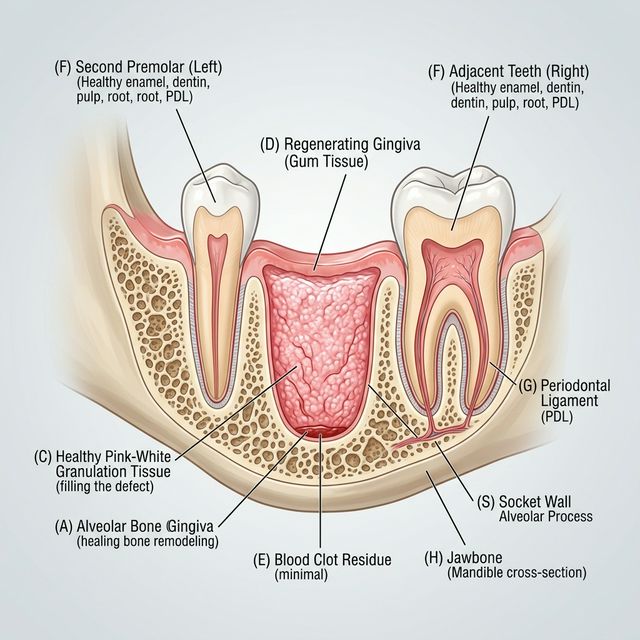
The blood clot that forms in your extraction socket acts like a protective cover. It protects the bone and nerve endings underneath while new tissue grows. When that clot is disrupted, you lose that protection.
Common causes of clot disruption include:
Suction in the mouth. Using straws, smoking, or spitting forcefully can create negative pressure that dislodges the clot. This is the most frequently cited cause in dental literature.
Rinsing too early or too aggressively. Vigorous swishing during the first 24 hours can wash out a fragile clot before it stabilizes.
Hormonal factors. Research published in the Journal of Oral and Maxillofacial Surgery shows that estrogen-based oral contraceptives may increase dry socket risk by affecting blood clotting mechanisms. Some dentists recommend scheduling extractions during days 23 to 28 of the menstrual cycle when estrogen levels are lowest.
Tobacco use. Smoking introduces chemicals that impair blood clot formation and healing. The physical suction of inhaling adds mechanical risk as well.
Pre-existing infection. When the tissue around a tooth is already infected before extraction, the inflammatory environment makes it harder for a stable clot to form.
Who’s Most at Risk
You’re at higher risk for dry socket if you:
- Smoke or use tobacco products
- Take oral contraceptives
- Have had dry socket before (recurrence rates are higher)
- Had a difficult or traumatic extraction, such as an impacted wisdom tooth
- Have poor oral hygiene around the extraction site
- Are over age 30, risk increases with age according to multiple clinical studies
How to Prevent Dry Socket
Prevention is a habit stack, not a shopping cart. Amazon “dry socket prevention kit” cards mix gauze, clove oil, and syringes that your dentist may not want you to use. Follow your own provider’s written instructions first. The precautions below are the ones aftercare handouts keep repeating:
Avoid straws for at least 5 days. The suction movement is the single most common trigger cited in aftercare notes. Sip liquids directly from a cup instead. Timeline context is in When Can I Use a Straw After Tooth Extraction?.
Don’t smoke for at least 72 hours, ideally avoid tobacco for the full first week. If you smoke and can’t abstain, ask your dentist about resorbable wound dressings — do not invent a home dressing. Smoking-risk notes are in Smoking After Tooth Extraction.
Skip vigorous rinsing for 24 hours. After the first day, switch to gentle warm salt water rinses (1/2 teaspoon of salt in 8 ounces of warm water) and let the rinse flow passively rather than swishing hard. An alcohol-free rinse is a later comfort buy if your dentist is fine with it — not a first-night substitute for salt water.
Eat soft, room-temperature foods. Avoid anything crunchy, spicy, or acidic that could irritate the socket. Texture options are in Best Soft Foods After Dental Surgery and the 7-day meal plan.
Follow your dentist’s medication schedule. If prescribed antibiotics, finish the full course even if you feel fine. This desk does not invent a dosing chart.
Sleep with your head elevated on a wedge pillow for the first 2 to 3 nights if that matches your aftercare sheet. Confirm the live loft is a wedge (about 7–10 inches), not a travel U-pillow. Pillow types are compared in Best Recovery Pillows.
Ice on the cheek, not in the socket. A jaw ice wrap is a first-48-hour comfort tool if your provider wants exterior cold. It does not “seal” a clot. Form-factor notes are in Best Ice Packs for Jaw Pain.
Research cost ranges (not a quote): Same-office dry-socket dressing visits are often billed as post-op care. If you have to see a new office, community fee notes commonly land in a roughly $75–$200 research band for a private visit, or less at a dental school. Confirm before you sit down. Logistics are in How to Find an Emergency Dentist for Dry Socket.
What Your Dentist Does to Treat Dry Socket
If you do develop dry socket, your dentist can treat it effectively, usually in one office visit:
- Irrigation, the socket is gently flushed with sterile saline to remove debris
- Medicated dressing, your dentist places a medicated paste (often containing eugenol, a clove-derived anesthetic) directly into the socket to cover the exposed bone
- Pain management, stronger prescription medication may be provided for the first few days
- Follow-up visits, the dressing is typically replaced every 1 to 2 days until the pain subsides and tissue starts covering the socket again
Most patients experience significant pain relief within 30 minutes of the medicated dressing being placed. Complete healing from dry socket still follows normal timelines, around 7 to 10 additional days, but the severe pain resolves much faster with treatment.
Dry Socket vs. Infection: How to Tell the Difference
Both dry socket and infection can cause pain after extraction, but they have different characteristics:
| Dry Socket | Infection | |
|---|---|---|
| Onset | Days 3–5 | Days 2–7 |
| Pain type | Deep, radiating, throbbing | Tender, swollen, pressure |
| Appearance | Empty socket, visible bone | Red, swollen gums, possible pus |
| Fever | Usually low-grade or absent | Often higher fever |
| Taste | Bad taste from exposed tissue | Foul taste from pus/discharge |
| Treatment | Medicated dressing | Antibiotics |
If you’re unsure which you’re experiencing, call your dentist. Both conditions require professional attention and neither resolves reliably on its own.
When to Call Your Dentist (Skip DIY)
Contact your dental provider if you experience:
- Increasing pain after day 2 that doesn’t respond to the pain plan your dentist already gave you
- A visibly empty socket where you can see bone
- Persistent bad taste, odor, or discharge
- Fever above 101°F (38.3°C)
- Pain radiating to your ear, eye, or temple
- Any difficulty swallowing or breathing — this requires emergency care, not a product page
When to skip DIY: Do not pack clove oil, do not irrigate a painful socket with a grocery-store syringe, and do not wait for an Amazon “dry socket kit” to arrive. Those cards are not a dressing visit. If you are also worrying that a neighbor tooth has already drifted, that is a later question — see Teeth Shifting After Tooth Extraction after the acute pain is evaluated.
For same-day care logistics after hours or away from your original office, see how to find an emergency dentist for dry socket.
Key Takeaway
Dry socket is painful, temporary, and treated in a dental chair — not with a kit. The useful first-week work is boring: no straws, no smoking, gentle rinses after day 1, soft food, and elevation if your aftercare sheet asks for it. If pain reverses around day 3 to 5, call. This desk will not tell you to self-pack the socket.
Related Reading
- Dry Socket Symptoms: How to Know If You Have One
- Teeth Shifting After Tooth Extraction
- Best Soft Foods After Dental Surgery
- Best Oral Rinses for Post-Extraction Healing
- Comfort habits for socket irritation
- What to Expect hub
- Pain-relief hub
- How to Find an Emergency Dentist for Dry Socket
Written and researched by the JawPainAfterToothExtraction Editorial Team. Sources: ADA guidelines, Mayo Clinic, peer-reviewed dental literature. We are an editorial desk, not a dental clinic.
Sources: International Journal of Dentistry; Journal of Oral and Maxillofacial Surgery; American Association of Oral and Maxillofacial Surgeons.