Front Tooth Extraction Recovery: What's Different
Written & Researched By
Editorial Team · product research desk
Sources: ADA guidelines, Mayo Clinic, PubMed, peer-reviewed dental literature
Published: September 20, 2026
Written & Researched By
Editorial Team · product research desk
Sources: ADA guidelines, Mayo Clinic, PubMed, peer-reviewed dental literature
Losing a front tooth, an incisor or canine, is a different experience from losing a back molar. The recovery process is actually less painful in most cases. But the challenges that matter most to patients are different: the visible gap, the effect on speech, the difficulty eating foods you normally wouldn’t think twice about, and the urgency of deciding what to replace the tooth with.
One way to picture the difference: your molars are the mill, and your front teeth are the desk. The mill does hidden, heavy work grinding every meal. The desk is what the world actually sees — the smile you present, the words you shape, the face you bring to meetings, photos, and video calls. Molar recovery is mostly about restoring grinding power in the back of the mouth. Front tooth recovery is about getting your desk back: how you look, how you sound, and how confidently you speak and smile while the socket heals underneath.
This guide covers what makes front tooth extraction recovery unique, and what your options are.
Why Front Tooth Recovery Is Often Less Painful
Front teeth (incisors and canines) have a single, straight root, making them significantly easier to extract than molars, which have 2–3 roots that can curve in different directions. Most front tooth extractions are simple procedures completed in minutes with local anesthesia. The Mayo Clinic’s patient guidance on tooth extraction describes the typical arc for simple extractions: a few days of managed discomfort while the socket keeps healing quietly for weeks afterward.
Expect:
- Pain level: Mild to moderate, often manageable with ibuprofen alone
- Swelling: Less than a molar extraction, typically noticeable but not dramatic
- Recovery time: 2–4 days to return to most normal activities
- Socket healing: 2–3 weeks for soft tissue to close visibly
The physical recovery is typically faster and more comfortable than patients expect. What tends to be harder is the aesthetic and functional impact.
The Desk vs. the Mill: Two Different Recovery Problems
Dentists often think about the mouth as two workstations with very different jobs. The molars are the mill — broad, multi-rooted teeth built to crush and grind, carrying the heaviest bite forces in your mouth. The front teeth are the desk — the workstation you present to other people, responsible for cutting food, shaping sounds, and framing your smile.
Almost every difference between front tooth and molar recovery follows from that split:
| Front tooth (the “desk”) | Molar (the “mill”) | |
|---|---|---|
| Root structure | Usually single and straight | 2–3 roots, often curved or splayed |
| Extraction visit | Usually simple, minutes | More force and longer chair time |
| Typical pain | Mild to moderate | Moderate, with more jaw soreness |
| First thing you notice | The gap, your speech, your smile | Chewing efficiency on that side |
| Function lost | Biting into food, articulation, appearance | Grinding food |
| Replacement urgency | High — the gap is visible within hours | Lower — hidden when you talk and smile |
The molar side of this comparison, including how wisdom teeth change the equation yet again, is covered in detail in molar extraction vs. wisdom tooth removal.
Two practical consequences of the desk-vs-mill split come up again and again during front tooth recovery:
All chewing moves to the mill. With the desk out of action, you cannot bite into anything, so every bite of work shifts to your back teeth. Chewing exclusively in one region day after day can leave your jaw achy and tired by evening. If that stiffness lingers into the second week, the jaw stiffness after extraction guide covers gentle stretches and heat routines that help, and the typical jaw pain timeline explains when soreness is still normal and when it is not.
Everything on the menu has to be mill-ready. Because you cannot incise, food has to arrive in pieces small enough to go straight to the back teeth — soups, scrambles, smoothies, and anything fork-mashable. Soft food options that actually taste good and the timeline for when you can eat solid food again make that constraint much easier to live with.
Immediate Challenges: The Gap
Eating Difficulties
Front teeth are responsible for biting, cutting food into pieces before molars grind it. Without them:
- Biting into sandwiches, apples, pizza crust, or anything solid becomes difficult or impossible
- You will naturally compensate by turning your head or tearing food with your hands, which feels awkward
- Chewing with only your back teeth strains your jaw more than usual
This is a short-term problem during healing, but it highlights why replacement planning is important for the long term. The later question of whether neighboring teeth can move into a visible front gap is covered in teeth shifting after tooth extraction.
Speech Changes
Many patients notice a slight lisp or change in their “s,” “f,” “v,” and “th” sounds immediately after a front tooth extraction. This is because the tongue uses the upper front teeth as a point of articulation during speech. The “s” sound is the most demanding of the group: the tongue tip aims a precise stream of air at the edges of the upper incisors, and when that surface disappears the air escapes sideways — which is the whistle or lisp you hear in your own voice.
The good news is that this is a hardware problem, not a retraining problem. Once a temporary tooth, even a modest flipper, restores the articulation surface, speech typically settles back to normal within days, and often faster with a little deliberate practice speaking with the appliance in place.
Social and Psychological Impact
This is something dental providers discuss less often than they should. The visible gap from a missing front tooth affects:
- Confidence in professional settings
- Willingness to smile in photos
- Speaking in public or on video calls
- Dating and social situations
These are legitimate concerns. Most patients are strongly motivated to get a temporary replacement as fast as possible, and they are right to prioritize it. If your week is heavy on video calls, the setup in working from home during dental recovery — camera positioning, scheduling around medication, low-effort lunches — is written for exactly this situation.
Your Temporary Tooth Options
You do not have to walk around with a visible gap. Several options are available immediately or within days of your extraction.
Flipper (Immediate Partial Denture)
A flipper is a removable acrylic prosthetic tooth attached to a thin pink acrylic plate that rests against the roof of your mouth or along the gumline. It is the fastest and least expensive temporary option.
- Cost: $300–$600
- Timeline: Can often be made before your extraction and placed immediately after
- Appearance: Adequate, looks like a real tooth from normal conversational distance
- Limitations: Not meant for heavy chewing; needs to be removed for cleaning; can feel awkward at first
For most patients having a front tooth extracted, a flipper is the right first step while the socket heals and longer-term replacement is planned.
Immediate Temporary Crown on an Implant
If your oral surgeon is placing an implant at the same appointment as the extraction, some cases allow for placement of a temporary crown on the implant the same day. This is called immediate provisionalization.
- Availability: Only possible in specific circumstances (sufficient bone, correct bite, experienced surgeon)
- Advantage: No gap, you leave the office with a tooth
- Cost: Part of the overall implant package, which typically runs $3,000–$5,000
Ask your surgeon at your consultation whether you are a candidate for immediate provisionalization. The replacement-timing questions in 20 questions to ask your dentist before a tooth extraction are worth raising before the extraction is even scheduled.
Maryland Bridge (Temporary)
A Maryland bridge uses a framework bonded to the backs of adjacent teeth to hold a temporary prosthetic tooth in place. Less common today but still used in certain situations where an implant cannot be placed immediately.
Long-Term Replacement: Planning the Implant
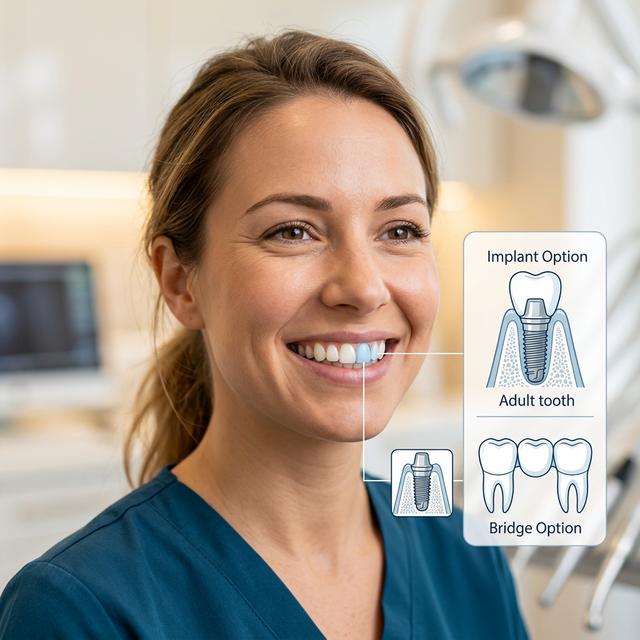
For a front tooth, a dental implant is the gold standard replacement, and in a visible location, the difference in appearance between an implant crown and a bridge or denture is significant. The Cleveland Clinic’s overview of dental implants describes the process as deliberately staged: the titanium post is placed in the jawbone, fuses with the bone over the following months, and only then receives its permanent crown. In the aesthetic zone that staging matters even more, because the gum and bone keep changing shape while it happens.
Implant Timeline for a Front Tooth
| Phase | Timing |
|---|---|
| Extraction | Day 0 |
| Socket preservation bone graft (if needed) | Same day as extraction |
| Healing / bone graft integration | 3–4 months |
| Implant post placement | Month 3–4 |
| Osseointegration (implant fuses to bone) | 3–6 months |
| Final crown placed | Month 6–10 |
Total timeline: 6 months to 1 year from extraction to final tooth.
This seems long, but the result is a tooth that looks, feels, and functions like a natural tooth, and can last decades with proper care. If the price of the implant is the main obstacle, managing tooth extraction costs without insurance covers payment plans, dental schools, and discount options that apply to replacement work as well as to the extraction itself.
Why Bone Grafting Matters More for Front Teeth
The bone and gum tissue in the front of the mouth is thinner and more cosmetically critical than in the back. If bone is allowed to resorb without a socket preservation graft, the resulting bone loss can:
- Make implant placement significantly more difficult
- Affect the gum tissue contour, causing the implant crown to look different from surrounding teeth
- Require a more complex augmentation procedure later
Ask your dentist at the time of extraction whether a socket preservation graft is recommended. The cost ($400–$800) is usually worth it for a front tooth, and the procedure itself is covered in bone graft after tooth extraction.
How Long Until the Socket Closes Visibly?
Patients often want to know how obvious the gap will be over time, especially under the flipper.
- Days 1–7: Socket is an open wound with healing tissue
- Weeks 2–4: Soft tissue closes over the socket noticeably
- Months 1–3: Socket continues to fill in; the gum contour changes slightly
- Months 3–6+: Bone remodeling underneath the surface continues, which can affect how a flipper fits (it may need adjustment)
For a photo-by-photo walkthrough of what the socket should look like week to week, see tooth extraction healing stages. This is another reason why finalizing your implant plan early matters — the longer you wait, the more bone and gum changes occur.
Tips Specific to Front Tooth Recovery
- Request a flipper before your extraction, not after. Most dental labs need 1–2 weeks to fabricate one. If you schedule it in advance, you can have it ready to place immediately after the procedure.
- Protect the socket from food, especially small particles like seeds, bread crusts, and grains that can lodge in the healing site.
- Be patient with speech. The slight lisp or change in articulation is temporary and corrects within days of wearing a temporary tooth. Reading aloud for a few minutes several times a day speeds the adjustment along.
- Avoid biting into hard foods even with a flipper in place — flippers are not designed for biting forces and can crack.
- Rinse gently after eating once your dentist clears it, commonly after the first 24 hours. Warm salt water helps keep small food particles out of an open site you cannot brush over yet.
- Plan your work calendar around the desk, not just the wound. Medically you may be fine to return in a day or two; if your role is public-facing or camera-heavy, schedule around the day your flipper or temporary is seated.
Front Tooth Recovery: Quick Answers
Is a front tooth extraction more painful than a molar extraction?
Usually the opposite. The single, straight root of an incisor or canine makes the procedure quicker and gentler than a multi-rooted molar extraction, and post-operative pain is typically mild to moderate. The harder part is aesthetic and social, not physical.
How long will the lisp last?
Until a temporary tooth restores the articulation surface. Most patients sound like themselves within days of wearing a flipper or temporary crown, and often sooner with practice. Without any replacement, the tongue slowly adapts on its own, but a temporary is the faster and more comfortable route.
When can I go back to work?
For desk jobs, most people return within 1–2 days, driven mainly by energy level and swelling rather than the extraction itself. For roles that center on speaking, presenting, or being on camera, the practical return date is often the day the temporary tooth is placed.
Do I need a bone graft for a single front tooth?
Not always, but the case for one is stronger in the aesthetic zone. The thin front bone and gum contour are what make an eventual implant crown look natural, and a socket preservation graft placed at extraction time is far easier than rebuilding bone later. Ask before the extraction, when it can still be done in the same appointment.
This article is for informational purposes only and does not constitute medical advice. Replacement options and timelines vary significantly depending on individual factors. Consult your dentist or prosthodontist for personalized recommendations.
We evaluate health information and products independently. To learn more about our editorial standards, read our Editorial Policy.