Best Water Flossers for Sensitive Gums After Extraction
Written & Researched By
Editorial Team · product research desk
Sources: ADA guidelines, Mayo Clinic, PubMed, peer-reviewed dental literature
Published: September 12, 2026
Affiliate Disclosure: This article contains affiliate links. If you purchase through our links, we may earn a small commission at no extra cost to you. This supports the editorial desk. See our full disclosure and How We Make Money.
Short answer: A countertop water flosser with adjustable pressure settings (like the Waterpik Aquarius or ION) is the best choice for post-extraction oral care. The ability to dial pressure down to a gentle setting is essential — your gums need cleaning, but aggressive water jets near a healing extraction socket can dislodge the blood clot and cause dry socket.
JawPainAfterToothExtraction is an editorial desk. We compile published dental guidance, manufacturer specs, and community consensus. We do not run an in-house lab or a test fleet, and we do not claim we personally treated patients. This is a pressure-dial convenience note, not a socket-flush protocol and not a promise that any jet prevents infection.
Listing check: Confirm a countertop irrigator with a numbered low-pressure dial — not a faucet-tap adapter and not a 3-mode cordless whose “gentle” is still a jet. This tagged URL is also reused as an instant-cold-pack card on the ice-packs guide, so read the live title before you click.
A single irrigator review is Water Flosser for Sensitive Gums. Hub picks live on Gentle Oral-Care Products. First-week brushing still starts with a skip-the-socket extra-soft brush, not a jet.
Before you buy (desk checklist)
- Did the written aftercare sheet say “no water flosser yet”? If yes, skip the purchase. Warm salt water is still the first-week default — see Best Oral Rinses.
- Numbered low setting: look for a dial or 10-speed list where setting 1 is actually labeled. Three vague modes (low / medium / high) are harder to keep gentle.
- Form factor: countertop reservoir vs travel tank vs faucet tap. A 5-oz travel tank is a refill chore; a faucet tap inherits your home water pressure.
- Shared-ASIN trap: the Aquarius-style URL on this site is also wired as an instant-cold-pack destination on another page. If the live title is a cold pack, do not check out.
- Research price: countertop units often sit in the $50–$100 band; cordless $25–$50; faucet taps $30–$60. Street prices go stale.
Why Water Flossers Show Up After Extraction
Aftercare sheets commonly ask you not to brush on the extraction site for several days. Plaque and soft-food debris still collect on the other teeth. A water flosser is a later convenience for those neighboring surfaces — not a hose for the hole.
What aftercare-style notes actually support:
- Gentle cleaning around teeth next to the site, if your dentist already said you may use one
- Flushing debris from back molars after yogurt and oatmeal — better prevented with the grocery list than blasted out
- Warm water in the tank if cold water stings
- Not “therapeutic rinsing” into the socket, even with salt water in the reservoir
Important: Typical sheets say wait at least 24 hours, keep pressure at the lowest numbered setting, and do not aim into the socket for the first week. Your sheet wins if it says wait longer.
What to Look for in a Post-Extraction Water Flosser
Adjustable pressure you can name. You need a setting you can point to (“1” or “low on a 10-speed”), then raise later. Fixed-pressure or “one strong jet” travel pens are a poor first-week match.
Tip options on the card. Standard jet for other teeth; orthodontic or periodontal tips are a later conversation with the office, not a DIY socket tip.
Reservoir size. Countertop cards often list 20 to 30+ oz. Cordless travel tanks often list 5 to 10 oz. That is refill math, not clinical superiority.
Noise. A quieter motor is comfort when you are sore. It is not a healing feature.
Top Water Flosser Options
1. Countertop Water Flossers
Best for: Home use once the office says an irrigator is allowed
Full-sized units with a reservoir and a corded wand. Waterpik, Bitvae, and H2ofloss names show up often.
What the spec sheets support:
- 10 pressure settings on many Waterpik-style cards — start at the lowest number
- Larger reservoir (22+ oz on many cards)
- Extra tips in the box
- Some Waterpik models carry the ADA Seal of Acceptance for ordinary flossing — that seal is not an extraction-week endorsement from this desk
Tradeoffs:
- Needs counter space and an outlet
- Not a travel kit item — pack salt packets instead; see Post-Extraction Travel Kit
- Research price: $50 to $100
2. Cordless/Portable Water Flossers
Best for: A second unit later, or a small bathroom, not day-1 recovery
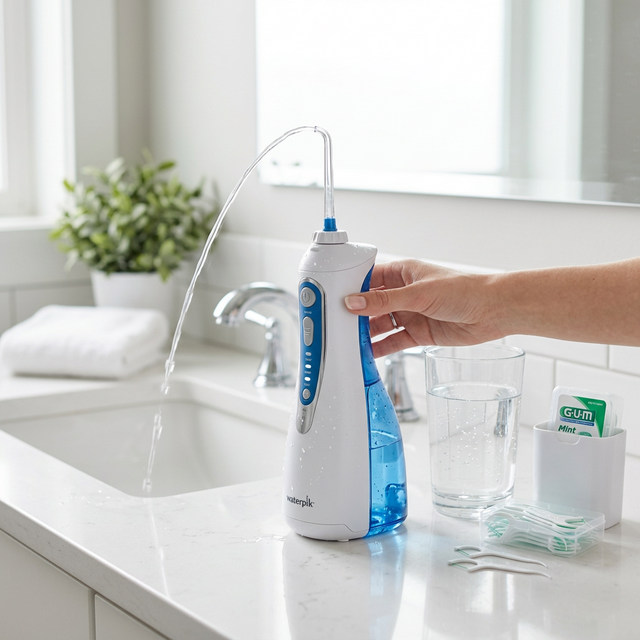
USB-rechargeable handhelds. Waterpik Cordless, Bitvae, and Nicwell names show up here.
What the spec sheets support:
- Portable
- Usually 3 to 5 modes, not 10
- Research price: $25 to $50
Tradeoffs:
- “Low” on a 3-mode pen can still feel like a jet
- Smaller tank, more refills
- Battery can die mid-pass
- Easy to take on a trip and use too early — that is when to skip DIY
3. Faucet-Connected Water Flossers
Best for: Households that already like a tap attachment — not the first extraction buy
Devices that tee into the bathroom faucet.
What the spec sheets support:
- Unlimited water
- No reservoir to wash
Tradeoffs:
- Pressure follows your tap, not a numbered dental dial
- Fit is faucet-specific
- Fewer models with a true gentle stop
- Hard to pack; useless in a hotel
Comparison Table
| Feature | Countertop | Cordless | Faucet |
|---|---|---|---|
| Research price | $50–$100 | $25–$50 | $30–$60 |
| Pressure control | Often 10 numbered settings | Typically 3–5 modes | Tap-dependent |
| Reservoir | 22+ oz (many cards) | 5–10 oz | None |
| Portability | No | Yes | No |
| First-week fit | Best if the sheet allows an irrigator | Only if “low” is truly gentle | Weakest control |
How Aftercare Sheets Usually Time an Irrigator
Follow your own written instructions if they differ. This is a planning sketch, not a treatment protocol.
Week 1 (if allowed at all):
- Wait at least 24 hours — longer if the sheet says so
- Lowest numbered setting only
- Start on teeth farthest from the site
- Do not aim into the socket
- Warm water
- Keep the first passes short
Week 2:
- Raise pressure only as comfort and the sheet allow
- You may work closer to the site without entering it
- Duration can look more like a normal session
Week 3+:
- Ordinary use if the gum has covered the hole and the office has cleared you
Safety Notes (recovery framing, not a procedure)
- Never put a high setting into the extraction socket in the first week
- Avoid forceful swishing that creates suction
- Warm water if cold stings
- Replace tips on the manufacturer’s hygiene schedule — that is cleanliness, not clot science
If pain reverses after day 2, stop shopping for a stronger jet and call about dry socket.
Tagged Amazon Cards (confirm the live title)
| Listing | Research price band | What to confirm before you click |
|---|---|---|
| Waterpik Aquarius WP-660 | About $70–$90 (research) | Live title is still a countertop irrigator with numbered pressures — not the instant-cold-pack reuse of this ASIN on the ice-packs guide |
| Waterpik Cordless Advanced WP-580 | About $80–$110 (research) | Cordless tank + mode list; confirm a genuinely low mode, not “3 powerful settings” |
| COSLUS Portable Cordless | About $25–$35 (research) | Travel pen. Confirm it is an irrigator, then keep it off the socket |
Desk shortlist (not a hygienist diary): The Aquarius-style countertop card is the listing that most often matches “numbered low setting” aftercare language. We did not time jets on patients, and we will not claim setting 1 is “safe around the site on day 7.” That timing belongs to your dentist. Cordless pens are a later convenience, not a first-week default. If the live title is a cold pack or a faucet tap, use a tagged countertop irrigator search instead.
When to skip DIY: Skip the whole category if the extraction sheet says no irrigator. Skip aiming into the hole “to flush food.” Skip buying a countertop unit the night before surgery because a carousel said it prevents dry socket — it does not. A personal blender and a sip-lid cup reduce the debris problem before a jet ever enters the room.
Key Takeaway
A water flosser is a later oral-care convenience with a numbered low setting — not week-1 default care. Salt water and a skip-the-socket brush still come first. Confirm the live title is an irrigator (this ASIN gets reused), start at the lowest number only if the office said you may, and never treat a jet as socket treatment.
Related Reading
- Best Blenders for Soft Food After Dental Surgery
- Best Soft Toothbrushes for Post-Extraction Recovery
- Post-Extraction Travel Kit
- Pre-Extraction Grocery List
- Water Flosser for Sensitive Gums
- Gentle Oral-Care Products
- Best Ice Packs for Jaw Pain After Tooth Extraction
Written and researched by the JawPainAfterToothExtraction Editorial Team. Sources: ADA guidelines, Mayo Clinic, peer-reviewed dental literature. We are an editorial desk, not a dental clinic.
Sources: American Dental Association; Journal of Clinical Periodontology.